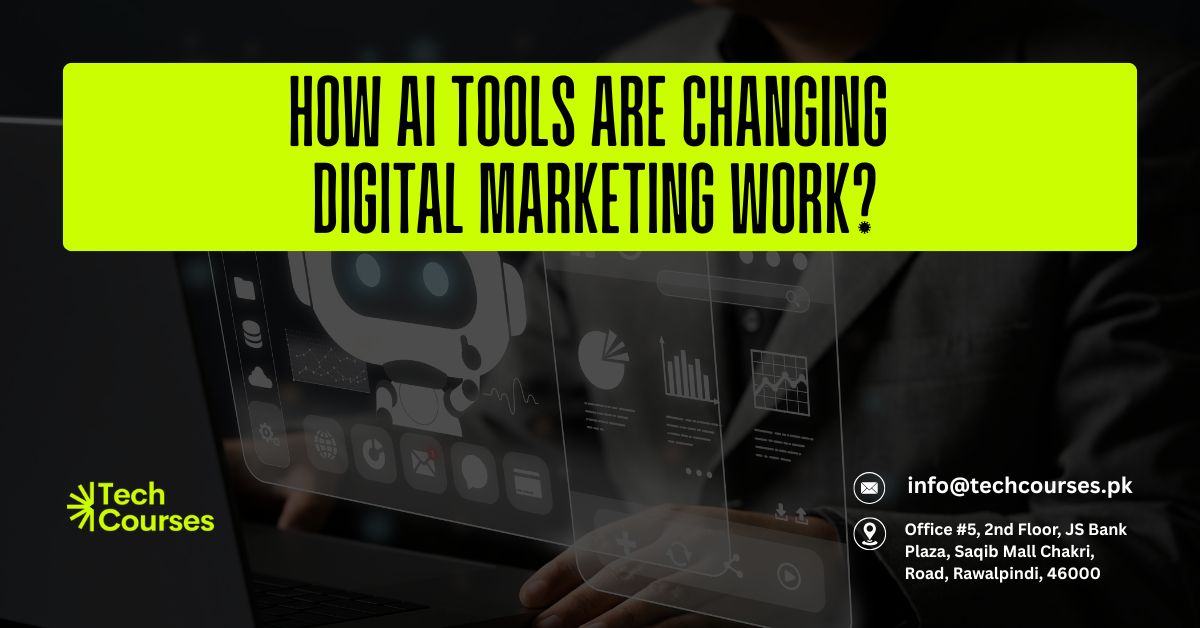
AI tools are changing digital marketing work by automating repetitive tasks like keyword research, ad bidding, and first-draft content, while shifting the marketer’s role toward strategy, prompt refinement, brand judgment, and campaign oversight. In Rawalpindi and across Pakistan, employers increasingly expect marketers to know how to direct AI tools, not just use traditional platforms, which is why hands-on, instructor-led training now includes AI tool practice alongside core SEO, ads, and social media skills.
Five years ago, a digital marketing executive’s day looked fairly predictable: manual keyword research, scheduling posts one by one, writing ad copy from scratch, and building reports in spreadsheets. That day looks different now. AI tools sit inside almost every stage of the workflow, from the first content brief to the final performance report, and the marketers who understand how to use them are finishing the same work in a fraction of the time.
This shift is not about AI replacing marketers. It is about the job itself changing shape. This post breaks down exactly how AI tools are reshaping day-to-day digital marketing work, which skills are becoming more valuable as a result, and what this means if you are building a career in digital marketing in Rawalpindi or Pakistan more broadly.
How Is AI Changing Digital Marketing Jobs?
AI is changing digital marketing jobs by taking over repetitive, data-heavy tasks such as bulk content drafts, ad optimization, and audience segmentation, while pushing human marketers toward strategy, creative direction, and quality control. The result is fewer entry-level tasks built around manual execution and more demand for marketers who can supervise AI output and make judgment calls.
A decade ago, an SEO executive might spend hours manually checking keyword volumes one at a time. Today, AI-assisted tools can surface hundreds of keyword variations, group them by intent, and suggest content angles in minutes. This does not remove the need for an SEO strategist. It removes the need for the slow, manual version of that work. Recruiters in Pakistan’s marketing job market are already reflecting this shift, favoring candidates who can combine core SEO and ads knowledge with fluency in AI-assisted workflows, rather than candidates who know only traditional manual methods.
If you’re mapping out the digital marketing skills worth learning for 2026, AI tool proficiency now sits alongside SEO, paid ads, and analytics as a core requirement rather than a bonus skill.
What AI Tools Are Digital Marketers Using Today?
Digital marketers today rely on AI tools across four main areas: content creation and copywriting, SEO and keyword research, paid ad optimization, and customer data or personalization. Most professionals use a combination of tools rather than a single all-in-one platform, matching the tool to the specific task at hand.
Rather than one AI replacing the marketer’s toolkit, the current landscape is modular. A content marketer might use one tool to draft blog outlines, another to check SEO readability, and a separate platform to generate social captions. An ads specialist might use AI-powered bid optimization inside Google Ads or Meta Ads Manager while using a separate tool to test ad copy variations. Understanding which tool fits which task, and how to combine them into a workflow, is quickly becoming a core marketing competency rather than a technical add-on.
How Is AI Used in Content Creation and Copywriting?
AI is used in content creation to generate first drafts, brainstorm headlines, repurpose long-form content into social posts, and check tone and readability, cutting the time from blank page to publishable draft. Marketers still handle fact-checking, brand voice, and final editing, since AI drafts are a starting point rather than a finished product.
This has changed what “writing skills” mean in a marketing role. A content marketer today needs to write clear prompts, evaluate AI output critically, and edit for accuracy and brand tone, rather than only writing from scratch. Tools built around this workflow include AI writing assistants for first drafts, SEO content checkers that score readability and keyword coverage, and repurposing tools that turn one blog post into multiple social formats. The marketers who get the most value from these tools are the ones who already understand good copywriting and can spot where AI output falls short, which is why foundational writing and SEO training still matters even in an AI-heavy workflow.
How Is AI Used in SEO and Keyword Research?
AI is used in SEO to cluster keywords by search intent, identify content gaps against competitor pages, suggest internal linking opportunities, and increasingly, to help pages get cited by AI answer engines like ChatGPT and Google AI Overviews. This last point, often called Answer Engine Optimization or AEO, is becoming as important as traditional ranking factors.
Search behavior itself is shifting because of AI. People increasingly ask AI chatbots direct questions instead of typing keywords into Google, which means SEO work now includes structuring content so AI tools can extract and cite it accurately. This includes writing direct-answer summaries early in a page, using clear headings, and adding structured data like FAQ schema. Marketers trained only on traditional keyword-stuffing SEO from a few years ago are having to relearn this part of the discipline. This is one of the reasons a proper Digital Marketing Course in Rawalpindi needs to cover both classic SEO fundamentals and how AI search is changing them, rather than teaching outdated tactics.
How Is AI Used in Paid Advertising?
AI is used in paid advertising primarily through automated bidding, audience targeting, and creative testing, where platforms like Google Ads and Meta Ads Manager use machine learning to allocate budget toward the highest-performing combinations in real time. This reduces manual guesswork but requires marketers to set the right goals and guardrails for the AI to optimize toward.
The risk here is that automated systems will happily spend a budget efficiently toward the wrong goal if a campaign is set up incorrectly. This means the marketer’s job shifts from manually adjusting bids to correctly structuring campaigns, choosing the right conversion events, and interpreting whether the AI’s optimization decisions actually align with business goals. Someone who does not understand the underlying logic of an ad account can misconfigure an AI-optimized campaign and waste a client’s budget quickly, which is why platform fundamentals remain essential even as the bidding itself becomes automated.
How Is AI Used in Social Media Management?
AI is used in social media management for caption generation, optimal posting time predictions, hashtag suggestions, basic image editing, and initial responses to common customer questions through chatbots. This automates the repetitive parts of running multiple accounts while leaving community management and brand voice decisions to the human marketer.
Small businesses in Rawalpindi and across Pakistan are increasingly using AI-powered scheduling and chatbot tools to manage their Facebook and Instagram presence without hiring a full-time social media team. This creates opportunities for marketers who can set up and manage these AI tools on behalf of local businesses, a skill set covered in local business marketing training such as guidance on digital marketing for small businesses in Rawalpindi.
What Can AI Not Replace in Digital Marketing?
AI cannot replace strategic decision-making, understanding of local market context, client relationship management, and the judgment needed to catch when automated output is wrong or off-brand. These remain distinctly human parts of digital marketing work, regardless of how advanced the tools become.
AI tools are trained on broad, often global data patterns. They do not inherently understand that a campaign targeting Rawalpindi audiences needs different messaging, timing, and cultural references than one targeting an international audience. A marketer who only knows how to prompt an AI tool without understanding the local market, the client’s actual business goals, or basic marketing principles will produce generic, ineffective campaigns. This is precisely why foundational, instructor-led training matters more, not less, in an AI-driven industry. A Digital Marketing Course in Rawalpindi taught face-to-face allows an instructor to correct misunderstandings in real time and connect AI tool usage back to real local business scenarios, something a recorded video course cannot replicate.
What Skills Should Digital Marketers in Pakistan Build Now?
Digital marketers in Pakistan should build a working knowledge of core AI-assisted tools across content, SEO, and ads, layered on top of solid fundamentals in strategy, analytics, and platform mechanics. Employers are looking for marketers who can direct AI tools intelligently, not marketers who rely on AI as a replacement for basic marketing knowledge.
This mirrors a broader shift already discussed in guidance on in-demand digital marketing skills for 2026: AI fluency is now expected alongside SEO, paid ads, content strategy, and analytics rather than instead of them. For someone just starting a digital marketing career in Pakistan, this actually lowers the barrier to entry for certain tasks while raising the bar for strategic thinking, since AI removes much of the tedious manual work but cannot substitute for understanding why a campaign should be structured a certain way.
How Does Tech Courses Train Students to Use AI Tools?
Tech Courses trains students to use AI tools within its in-person, instructor-led Digital Marketing Course in Rawalpindi, integrating relevant AI platforms into practical modules on content, SEO, and ads rather than teaching them as a separate add-on. Students practice applying these tools to real campaign scenarios under direct instructor guidance in the classroom.
Because classes are conducted face-to-face rather than through recorded video, students can ask questions in real time when an AI tool produces confusing or inaccurate output, something that is difficult to resolve through a pre-recorded online course. This hands-on format matters especially for AI tools, since the skill being taught is not just “how to use the tool” but “how to judge whether the tool’s output is actually correct and useful,” a skill best learned through direct feedback rather than passive video watching. If you’re comparing your options, our breakdown of in-person vs. online digital marketing classes covers this distinction in more detail.
Frequently Asked Questions
Will AI replace digital marketing jobs in Pakistan?
AI is unlikely to eliminate digital marketing jobs outright, but it is changing which tasks marketers spend time on. Roles built entirely around manual, repetitive execution are shrinking, while roles requiring strategy, AI tool oversight, and client communication are growing.
Do I need to learn coding to use AI marketing tools?
No. Most AI marketing tools used in content, SEO, and ads are designed with no-code interfaces. What matters more is understanding marketing fundamentals well enough to write good prompts and evaluate whether the AI’s output is actually correct.
Is it better to learn AI tools through an online course or in person?
Both approaches can teach the mechanics of a tool. In-person, instructor-led training has an advantage when it comes to catching mistakes, asking follow-up questions, and applying tools to real local business scenarios in real time, which is harder to replicate through pre-recorded online content.
Which AI skills should a beginner in digital marketing focus on first?
A beginner should first build a solid foundation in SEO, content strategy, and paid ads fundamentals, then layer AI tool usage on top. Understanding why a campaign works matters more than knowing which button to click in an AI tool.